Trump has resurrected an old plan the GOP has tried a few times before to eliminate the National Endowments for Arts and Humanities.
So I dug into the NEA archives and have been studying the NEA Grant list covering the last 10 years.
Here are things the NEA has helped fund in the last 10 years in the form of 42,485 grants, large and small:
Helped fund 319 Arts Apprenticeship programs across the nation, mostly for underserved (youth, minority, etc) teens, helping them get skills to preserve culture or get careers (or both).
Gave over 4000 grants to organizations to provide arts instruction free to poor kids and teens.
Gave over 7100 grants to help artists create their artworks, usually in the form of grants for artists residencies that connected professional artists with poor or disadvantaged youth for free lessons and workshops, brought artists to schools, or that provided entertainment for communities that couldn't otherwise have art because it's too expensive (plays, music performances, etc).
Gave 115 grants to organizations that give free tickets to kids to see professional shows.
Gave over 1100 grants to help produce radio and TV shows and audio recordings--mostly ones you see on PBS, but also ones that preserve our musical, folklife, and artistic history and present them to us.
Gave over 30 grants to organizations to expose Americans to the arts of the world, including groups that give free tickets and transportation to inner city kids and families to go to arts festivals and see all the shows free.
Gave over 1500 grants to make the arts accessible to the public (think arts weeks in schools, concerts, theater performances, museum exhibits, etc. Any time you saw art in your community, there's a good chance one of these grants was involved).
Gave over 10,000 grants to help support performances for the public. Even the highest calibre theater productions need help. It costs a fortune to put on any performance of anything any time, and the cost is prohibitive without grants. Without these grants, only the very wealthy would be able to go to performances, and most professional art in the nation would end. This would be a massive loss to the artistic community (nearly all artists would be out of jobs, as would theater staff, costume designers, tech guys, etc), as well as to our communities (because you couldn't afford to go to shows anymore, if there were any outside of NY and LA).
Gave 285 grants to help schools and organizations develop curriculum to teach kids and teachers about art. I use these materials all the time, and they're fantastic. It would be a great loss to the education and culture of our future if our students could never learn about art.
Gave 180 grants to organizations that provide art, movies, books, museum catalogs, CDs, etc to libraries and museums.
Gave 5 grants to help theaters get necessary equipment--mostly computers and software to help modernize old theaters.
Gave over 2800 grants to museums and cities to display art.
Gave 3 small grants to help build museums in communities.
Gave over 2600 grants to help fund arts festivals.
Gave nearly 1100 grants to fund fellowships in the arts, keeping the arts in our colleges as well.
Gave over 500 grants to help organizations digitize and preserve their art collections.
Gave 24 grants to help fund community arts programs, lectures, and classes, which often benefit disadvantaged children and the elderly.
Gave over 170 grants to help artistic journals stay afloat and to help communities promote their arts festivals.
Gave 519 grants to hard-to-categorize projects, most of which either brought art to poor children or helped preserve art and folklife and make it accessible to educators.
Gave almost 1200 grants to keep state arts councils alive.
Gave over 1800 grants to help theater and musical organizations bring their performances to areas that don't have theater or musical performances being produced locally (things like Shakespeare in the Park, or arts tours to rural, poor communities).
Gave over 1400 grants to help professional artists pass their skills on to the next generation and preserve dying arts.
Gave over 560 grants to help support arts organizations staff.
Gave over 1100 grants to help professional arts groups (theater companies, groups that bring art classes to inner city teens, etc) bring art to poor areas and to survive the economic crash of 2008.
Gave over 1300 grants to publications on the arts, especially magazines that help new writers get published and showcased.
Gave over 120 grants to organizations that give grants on a local level to artists, music, education programs, etc, that were likely going out of business due to decline in donations after the economic crash of 2008.
Gave over 580 grants to conserve existing art.
Gave over 1300 grants to help community planning to include the arts, organizational planning to help organizations like Ballet West stay in business, and research on how the arts can help people.
Gave nearly 500 grants to support arts conferences (like writer's conferences, arts alliance conferences, booking conferences, etc).
Helped fund 107 endowments in the arts.
Gave over 240 grants to train arts organizations or their employees (or both) how to do their jobs.
Funded the translation of over 220 works of literature into English.
Gave over 300 grants for the development and maintenance of websites on the arts.
Gave over 100 grants to support writing about art (journalism, books, etc).
Most of the grants they give are not very big for them, but are huge to the recipients. Without those grants, they would not likely stay in business. Or at least their services/tickets would become so prohibitively expensive that the arts would become the playground of only the very wealthy.
All of these projects the NEA funded or helped fund in the last 10 years had tangible, local, community influence. These are all things that touched individual and local community lives. In fact, if you did anything that involved any of the arts in the last 10 years on a community level (arts festivals, live performances, community performances, museums, arts education, libraries, etc.), you personally benefited personally from the work of the NEA.
The data shows that in the last 10 years alone, every single congressional district in the entire country plus all the commonwealths and territories have benefited from the work the NEA does at least 3 times (and all but one benefited four or more times). And that's just counting the grants. That's not counting other work they do, projects they run themselves, all the educational materials they produce themselves.
The obvious question is "Why would the government have any business funding these kinds of things?"
Here are my thoughts:
There are things that benefit our culture and our country as a whole that we value and that make life worthwhile for individuals and communities. There are things that keep people alive, and then there are things that make life worth living, that make people happy, that give families edifying and bonding experiences, that make our communities wonderful places to live.
Unfortunately, a lot of those enriching things are expensive to pay for, especially on a local community level. Most of the arts are prohibitively expensive. One of the functions of the federal government is to bolster communities in their efforts to make life worthwhile, to educate children, and to keep communities safe and happy. When something is expensive and not likely to return the investment to money-makers, but is worthwhile and valuable for making America wonderful, the government steps in to help. That's how we have infrastructure like bridges. That's how we have public education. That's how we have public universities. That's how we have national parks. And, even though the arts stuff is produced on the local level or in the schools, that's how we have arts in our communities, too.
I don't think people are aware how much the arts cost (and that's not funding them well at all--artists and arts organizations are usually starving!), but people appreciate the existence of arts in schools and in their communities. And I'm sure that most people are not aware that the federal government is quietly playing a role in helping all the arts and arts organizations to not collapse and disappear.
Historically speaking, communities have established and advertised their value and sophistication by providing arts for their members. Even in the old west, towns would prove they were established, civilized, and great places to live by funding town brass bands, theaters, and opera houses. They held festivals and parties and dances that featured live music. They put on shows. They paid for statues or commemorative paintings. They brought in travelling exhibitions and touring music ensembles. Even in the old west! This is not a new thing. The arts make life wonderful. The arts are so important that even in frontier Utah, Brigham Young made sure artists were getting top-notch training in Europe so they could come back and produce art for the frontiersmen. People need art. People need literature. People need music and dance and theater. Their bodies might not die without it, but their souls and their communities do.
The work of the NEA touches every one of our lives, and it would be a massive blow to arts in the United States, to our quality of life, and to our art communities (who would not exist without the help of the government--especially in the digital age where people believe that their art and music should be free). Without the support of things like residencies, state arts councils, arts tours, and community fairs and festivals, concert series, etc, I don't know of any artists that would survive, since individual consumers largely refuse to pay for their arts anymore. The entirety of arts would suffer because nobody wants to fund something that benefits people but does not bring any return on the investment in terms of dollars and cents. You won't get rich bankrolling the arts, so nobody wants to do it.
That's why, if we want or need any of the arts where we can touch them--in our homes, in our schools, in our communities, we need the NEA. This isn't some far-off program that only touches professional artists in New York and LA. This is a program that brings art to all of us, to enrich all of our lives.
Yes, there are philanthropists who donate huge amounts to the arts. But it takes them and the NEA to keep things going, and to keep arts in our communities. Philanthropists don't have the reach or the resources the government has. And, judging by the NEA rolls, the philanthropy drops off just when the people need arts the most: when the economy crashes and life gets hard.
What I'm trying to say is I dug through their data, which is freely available on their site, and it is clear if you look at what they actually do that our whole country would suffer a great loss if the NEA were erased. It would cause economic loss in every community that uses NEA funds (lost jobs, lost tourist dollars, lost arts dollars, lost "ripple" dollar). It would damage our educational systems. It would hurt our museums and libraries. It would make our lives more bleak. It would remove access to the arts from all the poor, the elderly, the disabled, and thousands upon thousands of communities that function fine but can't necessarily afford a theater or don't have enough dancers for a dance company or singers for a choir. Everything would be more expensive and less available. Our country would be a sadder, grayer, more unhappy, less healthy place.
A quick google search can show you (as it did me) that there are hundreds of research papers discussing the value of arts in our communities, for our youth especially, and in our schools. (This, for example, discusses the difficulties of discussing the issue at all, but covers a lot of different kinds of benefits the arts have for all of us: http://www.mvgeorgia.org/wp-content/uploads/2015/07/art-and-community.pdf.)
I know the regular conservative "line" is that the government has no business funding the arts. But the government does have business funding things that improve our lives that the free market won't fund because it's not cost-effective. Like roads. Charity health clinics. Public schools. Libraries. Museums. National Parks. And community arts.
And, quite frankly, I don't want to live in a world without the arts, and without the NEA, we who are poor are destined to just that.
Tuesday, January 24, 2017


Sunday, January 01, 2017
Emmy says....
Em, just a week shy of 2 years old, just excitedly brought me a DVD and said, "It has clues clues on it!" (her name for Blues Clues).
No, but it did have the movie "Clue" on it.
I guess she recognized the word? As in, she read it by memorizing the shape of that word? She can't even reliably name the letters yet (last she told me, the alphabet was, "A, B, Moon, Emmeline, Daniel...."), but I guess she can read that one word.
No, but it did have the movie "Clue" on it.
I guess she recognized the word? As in, she read it by memorizing the shape of that word? She can't even reliably name the letters yet (last she told me, the alphabet was, "A, B, Moon, Emmeline, Daniel...."), but I guess she can read that one word.
Thursday, December 15, 2016
Emmy says
Em was really excited when 3 yo asked to ride the elevator down, and she was deeply disappointed when we did. She thought he had said "alligator."
Wednesday, December 14, 2016
Emmy says a lot of fun things, and also Dan
Emmy found a large stuffed Disney character at the store and carried it all around, happy to have "Icky Mouse" to hug.
Dan says: "McDonald's scrambled eggs looked like they could be a communicating life form."
Emmy threw a temper tantrum because she's not old enough to go to Young Women's Wednesday activities yet. "I want to come with my womens!" she screamed over and over.
Emmy is so competitive.
Me to Em: "Are you stubborn, just like your mom? Just like me?"
Emmy: "No! Me like Mom. Not you like Mommy!"
Me: ...
Dan says: "McDonald's scrambled eggs looked like they could be a communicating life form."
Emmy threw a temper tantrum because she's not old enough to go to Young Women's Wednesday activities yet. "I want to come with my womens!" she screamed over and over.
Emmy is so competitive.
Me to Em: "Are you stubborn, just like your mom? Just like me?"
Emmy: "No! Me like Mom. Not you like Mommy!"
Me: ...
Saturday, December 10, 2016
Emmy says,
1 yo is highly competitive and independent. Yesterday it was:
Me: "I need to blow my nose."
Em: "NO! Boogers are mine. _I_ blow nose."
Today:
Me: "I got up at 10:30 am yesterday, and 11:00 am today! Hooray!"
3yo: "But I got up at 13."
Em: "I get up at twenty. One." (said as though on second thought, twenty was not a big enough number.)(I didn't even know she knew "twenty.")
I lift her off my bed.
"No! Me do it!" She climbs back on so she can slide back off herself.
I put her diaper on.
"No! Me do it!" She takes her diaper half way off and realizes that she can't do it, so she says, so sweetly, "Mommy tab it up." I do. She rips it open again. "No! Me do it!"
Tuesday, December 06, 2016
Jack says....
3 yo Jack, telling me he found the paper that tells how to build a toy wooden car: "Mom! I found the constructions!"
Friday, December 02, 2016
Did I just read that?
This is for real. Also funny. The whole article is actually quite delightful, from peanutbutter covered M&Ms all the way to raining chicken heads from the helicopter.
"GOVERNMENT DRONES WILL SHOOT VACCINATED M&MS AT PRAIRIE DOGS"
http://www.popsci.com/government-drones-will-shoot-vaccinated-mms-at-prairie-dogs-to-save-ferrets?con=TrueAnthem&dom=fb&src=SOC&utm_campaign=&utm_content=5841ccea19d6ba0006744a11&utm_medium=&utm_source=
"GOVERNMENT DRONES WILL SHOOT VACCINATED M&MS AT PRAIRIE DOGS"
http://www.popsci.com/government-drones-will-shoot-vaccinated-mms-at-prairie-dogs-to-save-ferrets?con=TrueAnthem&dom=fb&src=SOC&utm_campaign=&utm_content=5841ccea19d6ba0006744a11&utm_medium=&utm_source=
Friday, November 18, 2016
Did I just read that?
"This once was the grand restaurant, bar and lounge in downtown Ritzville and could be once again. Ritzville is growing and is the need for a great downtown gathering place. Comes with two pool tables and full restaurant kitchen. Interior has been removed and ready for your imagination." http://www.zillow.com/homes/for_sale/house_type/2096412449_zpid/1-225001_price/0-835_mp/5000-_size/globalrelevanceex_sort/48.516604,-90.131836,30.713503,-120.146485_rect/4_zm/0_mmm/
The fact that there is a town called Ritzville tickles me. Like some kind of a cartoon city for snooty people.
Also, the interior has been removed made me laugh out loud. Like--how did they remove the interior? What happens when you open the door--you walk into a wall because the interior of the building no longer exists? Reverse tardis building.
The fact that there is a town called Ritzville tickles me. Like some kind of a cartoon city for snooty people.
Also, the interior has been removed made me laugh out loud. Like--how did they remove the interior? What happens when you open the door--you walk into a wall because the interior of the building no longer exists? Reverse tardis building.
Monday, October 31, 2016
Arguments Against McMullin Answered: He's only out to stop Trump, not Hillary (I heard him say so).
There is a very short video clip being passed around as "proof" that McMullin is only trying to stop Trump, with the implication being that he is, therefore, obviously a Clinton plant.
This one is easy to answer with two words: Selective Editing.
You can make anyone seem to believe almost anything if you simply selectively edit their words. That's what happened here.
If you watch the full video, instead of the 50-second clip, you will see that Evan openly talks about stopping both Trump and Clinton. This is consistent with the hundreds of other interviews he has given.
The full interview is here: https://www.youtube.com/watch?v=2TKAwrKwgzY&feature=youtu.be
And you can see another interview that supports this one here: https://www.youtube.com/watch?v=Fv0MXhgLgXQ&app=desktop
This one is easy to answer with two words: Selective Editing.
You can make anyone seem to believe almost anything if you simply selectively edit their words. That's what happened here.
If you watch the full video, instead of the 50-second clip, you will see that Evan openly talks about stopping both Trump and Clinton. This is consistent with the hundreds of other interviews he has given.
The full interview is here: https://www.youtube.com/watch?v=2TKAwrKwgzY&feature=youtu.be
And you can see another interview that supports this one here: https://www.youtube.com/watch?v=Fv0MXhgLgXQ&app=desktop
Sunday, October 30, 2016
Arguments against McMullin answered: He's being paid by Hillary to help Trump lose
Evan and Mindy addressed this one best themselves:
http://ijr.com/wildfire/2016/10/723426-evan-mcmullin-has-some-straight-talk-for-conspiracy-theorists-who-think-hes-funded-by-hillary/?utm_source=facebook&utm_medium=social
That rumor was based on a fake invoice produced and circulated by a man who admitted it was a hoax.
http://www.theblaze.com/stories/2016/10/17/rumor-check-man-behind-clinton-foundation-invoice-circulated-on-social-media-admits-it-is-fake/
Besides, tell me again how this would be a good strategy by Clinton? This would be a waste of her money.
http://ijr.com/wildfire/2016/10/723426-evan-mcmullin-has-some-straight-talk-for-conspiracy-theorists-who-think-hes-funded-by-hillary/?utm_source=facebook&utm_medium=social
That rumor was based on a fake invoice produced and circulated by a man who admitted it was a hoax.
http://www.theblaze.com/stories/2016/10/17/rumor-check-man-behind-clinton-foundation-invoice-circulated-on-social-media-admits-it-is-fake/
Besides, tell me again how this would be a good strategy by Clinton? This would be a waste of her money.
Saturday, October 29, 2016
Arguments against McMullin answered: "He's Not Vetted"
"Vetting" a candidate is doing a thorough background check to see if there is anything in the candidate's background that would disqualify them or make them unelectable or unlikely to win.
People say, "I can't vote for McMullin because he wasn't vetted."
This is just blowing smoke for several reasons.
1. Presidential candidates usually aren't vetted. They send teams to vet the vice presidential candidates they choose. Neither Clinton nor Trump was vetted before getting the nomination.
2. The purpose of vetting is to figure out if there is anything in a candidate's background that would make them unsavory, unqualified, or unable to run. So what someone is saying when they bring this up is they can't vote for McMullin because there might be something awful in his past; he might not be "squeaky clean." This coming from supporters of Trump and Hillary.... If having something in your background that is not all clean disqualifies you from running in this election, then we haven't got anyone left EXCEPT McMullin.
In short, if vetting is an issue for you, Trump and Clinton are disqualified on that point, too, both for the reasons that they have not been formally vetted and because they have unsavories in their backgrounds that should have disqualified them.

Edited: Sue Fritzler pointed this out, and I think it's important: "McMullin is the only candidate who has been fully vetted. The CIA vetted him and gave him top security clearances. The House Republicans vetted him when they hired him as their Chief Foreign and Domestic Policy Director, where, again, he had top security clearances. The primary process gave us Hillary and Donald, who 79% of Americans disapprove of and who both have either FBI, civil or criminal cases pending against them."
In short, if vetting is an issue for you, Trump and Clinton are disqualified on that point, too, both for the reasons that they have not been formally vetted and because they have unsavories in their backgrounds that should have disqualified them.

Edited: Sue Fritzler pointed this out, and I think it's important: "McMullin is the only candidate who has been fully vetted. The CIA vetted him and gave him top security clearances. The House Republicans vetted him when they hired him as their Chief Foreign and Domestic Policy Director, where, again, he had top security clearances. The primary process gave us Hillary and Donald, who 79% of Americans disapprove of and who both have either FBI, civil or criminal cases pending against them."
Sunday, October 23, 2016
Evan McMullin and the Elections, part 2: Will Voting for Evan McMullin make the guy I dislike win?
So the last blog post was focused more on the theoretical, giving people information they need to answer (often harsh) accusations they are encountering online on a regular basis. (You can read that here: http://beccajones.blogspot.com/2016/10/evan-mcmullin-and-elections-part-1-is.html)
This post, in contrast, is for people (and there are many of you--you keep talking to me about this) who want to vote for Evan McMullin but absolutely cannot do it if it means that Donald Trump/Hillary Clinton will win the presidency. Let's cover them one at a time. I'm going to focus on the reality here in Colorado because everyone who has expressed this concern to me is in Colorado. The analysis of this varies based on what state you are in.
Will voting for Evan McMullin accidentally make it so Donald Trump wins? Because you don't want Donald Trump to win above all else....
The Fear:You like what Evan McMullin stands for, and you like the idea of a viable third party having a foot in the race in the future, and you want to send a message to the party bosses that McMullin is more in keeping with what you are looking for in a candidate. But you are only a #NeverTrump person, not necessarily a #NeverHillary person, and you are afraid to vote for Evan because you don't think Evan can win outright (reasonably), and you fear your protest vote might mean Hillary won't get enough electoral college votes nationwide, and Trump will win.
The Reality:
I've done a lot of research on this over the last few days, trying to determine if there is a chance that Trump could possibly win the election if Colorado goes to Trump instead of Hillary.
I combined the information from this article: http://abcnews.go.com/Politics/longshot-path-donald-trump-win-270-electoral-votes/story?id=42971946 with the information at these two polling/prediction sites: http://www.270towin.com/2016-polls-clinton-trump/ and http://projects.fivethirtyeight.com/2016-election-forecast/. I chose that article because it is reasonable and balanced and focused on how Trump could win, not all the reasons he is losing. And I chose those two sites for polling information because they are widely accepted and respected, and they pull their information from carefully vetted, widely-respected sources. 270toWin.com uses polling averages from the last 5 polls, minimizing the chances that I was just getting an anomaly or a bump or dip day. FiveThirtyEight, run by Nate Silver, is one of the most well-respected statistical analyses of elections there is. He has something like a 99% accuracy in his predictions, and he's open on his methodology and mistakes.
In the article, it mentions Trump has to do 4 things in order to win (whereas Clinton has dozens of paths to win): 1. Take every single state that Romney won in 2012; 2. Win Ohio. 3. Win Florida. 4. Win 17 other random electoral college votes from states in play or states that could be wildcards (PA; or IA+NV+NH+1/2ME; or WI+1/2ME+NV or IA; or VA+NV or IA or NH; or CO+IA+ NV or NH). Without doing all four of these, Trump can't reach 270 electoral college votes.
So what's the breakdown?
1. UT has been called by Nate Silver for Evan McMullin, so Trump cannot take all the states Romney won in 2012. But even if he wins UT....
2. Ohio is all over the place. Clinton and Trump are neck-and-neck there. It could go either way. Let's call it for Trump, just for the sake of our analysis here.
3. Florida is projected to go to Clinton. Five of the six most recent polls in FL show Clinton winning even with third party candidates included in the race. And the sixth had Trump ahead by only 2 percentage points--and then only if the third party candidates act as spoilers.
4. Even including potential 3rd party spoilers, Clinton is ahead by 6% in PA; In IA, Trump is ahead, but for this option to work he'd also have to take NV, NH, and half of ME, and he's losing in all three of those states, although NV is close; Clinton has a strong lead in VA, so that option won't work even if Trump wins IA; and even if Trump were to take CO (he's polling to lose here) and IA, without NV or NH (where he's losing), he still can't get these.
In other words, 1 is unlikely, 2 is possible but not a given, 3 is unlikely, and 4 is highly unlikely.
Here is a map illustrating this:
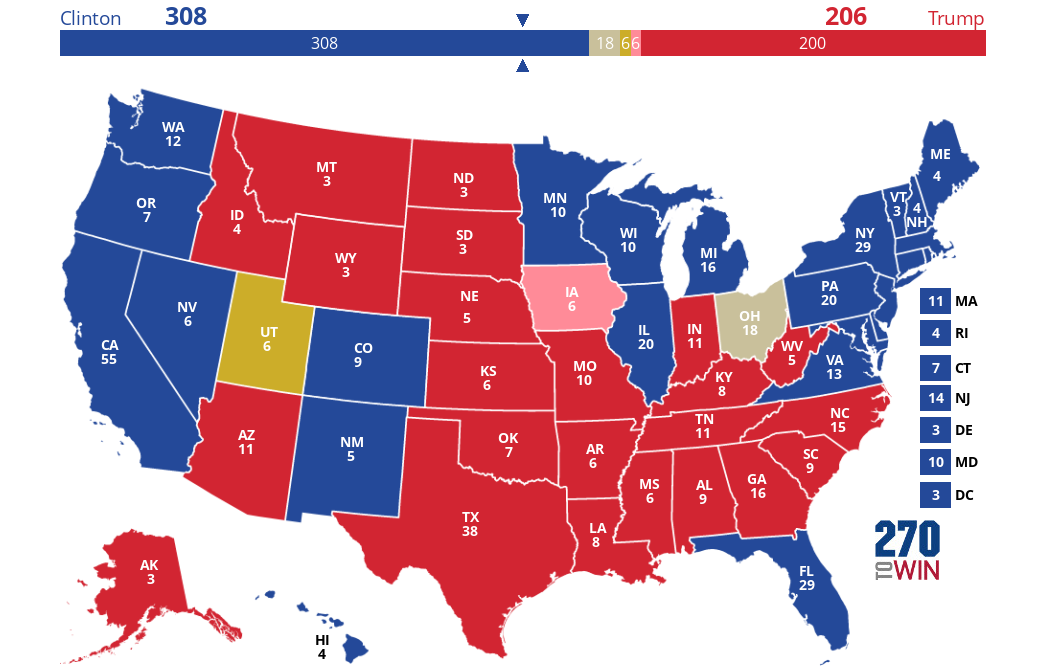
 Click the map to create your own at
 You can see that even if Trump collects 18 from Ohio and 15 from UT and CO (33 all together), he still cannot reach 270 electoral college votes.
SO...
Even if Colorado goes to Trump because Evan McMullin gets all the undecided plus enough of Clinton votes to pull her down that much, Trump still cannot win the national vote.
So you can safely vote for McMullin in Colorado and know that Trump won't win anyway.
So what are the numbers in Colorado? Will McMullin make a difference here?
We don't actually know. There hasn't been a poll done in Colorado that includes Evan McMullin's name. Apparently one is being done here tomorrow (Monday, Oct 24) that includes McMullin, but we don't know what it will say. Recent polls show Clinton winning Trump by 5-10% in Colorado. What is most interesting is the polls also show over 18% of the voters choosing a third party candidate or undecided. This is dramatic, and enough to make Trump win if those voters moved to him, but given that they are supporting Johnson and Stein primarily (and "other"), who are more liberal than Trump, it doesn't seem likely they would go to Trump should they decide to vote major party instead of protest.
But, like I said, even if they did tip the scales and Trump won here in Colorado, it wouldn't make a difference nationwide.
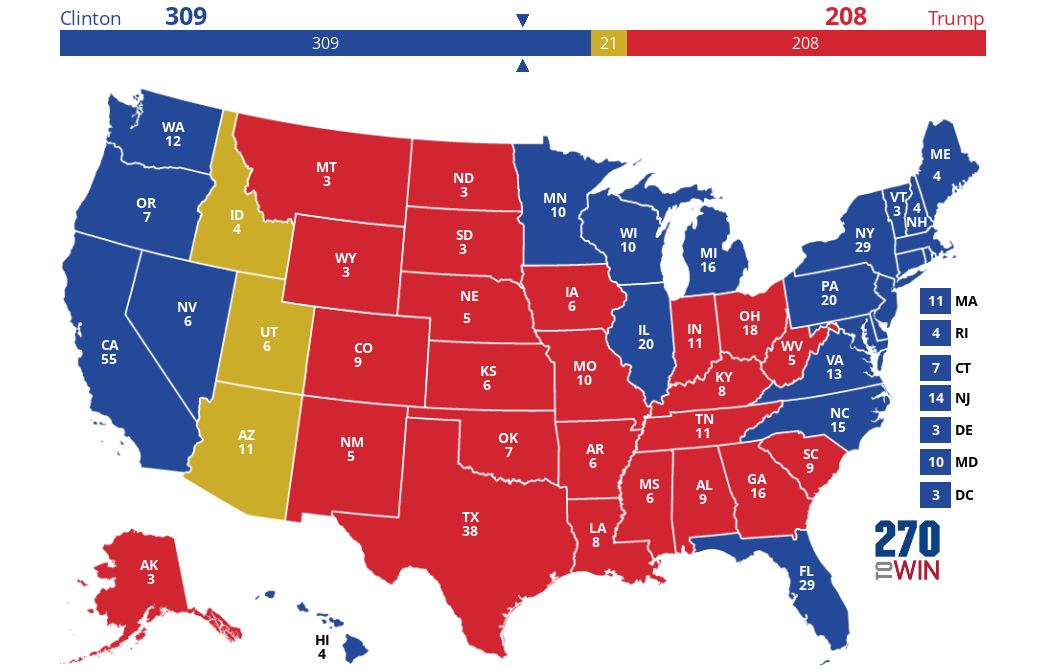
And what if Evan McMullin takes the three states he's most likely to take? (ID, UT, and AZ):
As you can see, Trump still cannot win, even if he wins IA, OH, and Colorado. In fact, this gives us a buffer and makes it possible for Trump to win Florida and Colorado and still lose the election.
Will voting for Evan McMullin accidentally make it so Hillary Clinton wins? Because you don't want Hillary Clinton to win above all else....
The Fear:You like what Evan McMullin stands for, and you like the idea of a viable third party having a foot in the race in the future, and you want to send a message to the party bosses that McMullin is more in keeping with what you are looking for in a candidate. But you are only a #NeverHillary person, not necessarily a #NeverTrump person, and you are afraid to vote for Evan because you don't think Evan can win outright (reasonably), and you fear your protest vote might mean Trump won't get enough electoral college votes nationwide, and Hillary will win.
The Reality:At this point, Trump's numbers are rapidly sinking. He is not projected to win enough electoral college votes to even approach 270 votes. Consequently, even if Colorado goes to Trump, that's not enough electoral college votes to stop Hillary nationwide. Either way (Trump or Evan), you're voting for a losing candidate, so why not send a message that you like with your vote?
Or, better yet, bank on the implausible-but-not-impossible idea that if all the people who are abandoning Trump because he can't win anyway band together and join another candidate, they can still stop Hillary. Join Evan McMullin and encourage your friends to do the same. If your goal is not to support Trump, but merely to stop Hillary, then jump to the candidate who is most likely to do that and campaign your guts out! At the very least, wait until the 8th to vote instead of voting early so you know more clearly what's going to happen.
So why not campaign your guts out for Trump and hope for a rebound--can't he recover and beat Hillary that way?
I don't think he can. Why? Because he keeps opening his mouth. The more he talks, the less appealing he is to many voters. He cannot regain the trust of the hispanics, women, muslims, Mormons, or many black voters. Without any of those blocs voting for him, he can't win. And he's offended them all too deeply to say or do anything to change their minds. In short, the only thing keeping him from sinking into nothingness is everyone's fear of a Hillary presidency--and it's looking like we're going to have that anyway. Since the establishment candidate can't stop Hillary, it might be time for the Hail Mary pass.
Evan McMullin and the Elections, Part 1: Is Evan McMullin a Spoiler this election?
This is the most complicated blog post I've ever worked on. I'll try to make everything clear, but there's a lot to cover! I'll do it in two parts: "Is Evan a spoiler?" and "Can I safely vote for Evan and not make my most disliked candidate win by accident?"
The most common question I get, working on this campaign, is "Is voting for McMullin going to get _______ elected?" Sometimes it comes in vitriole from Trump supporters. Sometimes it comes in quiet, private conversation from concerned friends. Sometimes it's online. But everyone remembers Ross Perot, and everyone has heard that old, tired line that a vote for a third party is a vote for _____ (whoever my enemy is).
I keep hearing people worried that McMullin is a "spoiler" who will push the election in a direction they don't want it to go.
So what is a Spoiler?
A "spoiler," in election terms, is a candidate who shows up and takes enough of the vote to prevent someone else from winning, without actually winning themselves.
There are actually two fairly common (as far as an uncommon thing can be called "common") scenarios that illustrate the concept of a spoiler making it so a good candidate doesn't win.
The First Scenario There is one really lousy candidate who happens to have a steady following. It's a small following, like 30% of the voters--not enough to win, but steady. One single other even tolerable candidate could easily beat this person, but there is not just one other candidate in the running. Instead, you have 3 or more candidates opposing this person. Instead of one person getting 60% and trouncing the bad apple, each of them gets 20% or less. Nobody gets over 30%, and the worst candidate wins. (These numbers are obviously oversimplified, but you get the point.) All of the too-many candidates are spoilers for each other--none have enough pull to win outright, but they keep the votes away from everyone else, allowing the least-liked (or less-liked) candidate to win.
This is exactly what happened in the Republican Primaries in 2016. There were more votes cast against Trump than any other candidate in the history of the Republican Party. But because they were not all cast for one or two other people, the candidate the majority did not like won the nomination.
This is usually the case with third parties as well. If all the people who dislike a single candidate cannot coalesce behind a single other candidate, the disliked major party candidate will still win.
The Second Scenario
There are two fairly decent candidates running who are close to evenly split in their following. Let's say one has 53% of the vote and the other has 47% of the vote. Clearly the one with 53% is winning, even though it's close. But then along comes a third party candidate. He pulls in only 8% of the vote, but it all pulls from the guy who had 53%, dropping him down to 45% of the vote. The person who the majority did not want therefore wins the election.
This is the situation people cite all the time in 1992 where Ross Perot siphoned votes off George Bush, letting Bill Clinton win.
So when people hear you are voting for a third party candidate and they say, "But a vote for him is just a vote for my enemy," this is what they're talking about. It isn't actually a vote for the enemy, but it's a vote that allows the so-called enemy to win simply by preventing enough votes from going to the favored candidate. "You might as well just vote for ___enemy," they say. And they have a point, whether you vote for ____enemy or not, you have prevented someone else from beating them.
Limitations of the Spoiler Concept
There are some clear limitations to the concept of a spoiler. Not all third party candidates who get votes are spoilers.
For a third party or independent candidate to be able to "spoil" the election for someone, these conditions have to be met:
A. The two major party candidates have to be in a close race.
B. The third party candidate has to hit a sweet spot in the vote percentages. They have to be able to pull enough votes to unbalance the race, but not enough for it to be considered a three-way race. In other words, they can't have a chance of winning, but they have to get enough votes to make a splash.
C. The third party candidate has to primarily or exclusively pull votes from only one of the major party candidates.
If all three conditions are not met, the third party candidate cannot be considered a spoiler.
If condition A is not met and the two major party candidates are not in a close race--one is clearly winning--the third party candidate did not spoil the race for the loser because the loser would have lost had the third party candidate not existed.
If condition B is not met because the third party candidate has too few votes to change the outcome, they are not a spoiler because they didn't change the outcome.
If condition B is not met because the third party candidate has enough votes to potentially win outright, the race is considered a competitive three-way race. They are not, therefore, spoiling for anyone but merely competing on level ground. Remember, a spoiler has to spoil someone's chances of winning without having a legitimate chance to win themselves.
If condition C is not met because the third party candidate is pulling from both major party candidates or from somewhere else (like from other third parties or from undecideds or from people who had decided not to vote at all), they are not a spoiler because they didn't unbalance things in favor of one major candidate in a way that caused the other (and only the other) to lose.
The Limitations of Data-Gathering During Elections
Obviously, we can't actually know what is going to happen in the future. We can only guess.
Consequently, we cannot declare beforehand with absolute certainty whether a candidate is a spoiler or not. We can only discuss whether they are likely to be a spoiler or not.
Unfortunately, our only sources of information about where a race is going are polls and expert pundits. And both are notoriously imperfect. However, many are not as unreliable as candidates who are losing would like you to believe.
Some polling organizations are more reliable than others. You can see an analysis here: http://projects.fivethirtyeight.com/pollster-ratings/.
Some reasons, briefly, why a poll might not be a reliable indication of where the race stands:
*The poll didn't even include a candidate who actually is impacting the race
*The pollsters asked the wrong question. "If the election were today, would you vote for Trump or Clinton?" will get you very different results from "If the election were today, who would you vote for?" Even just asking "Clinton or Trump" vs "Trump or Clinton" can skew your results.
*The poll is too old
*The poll is not scientific (they only called people with landlines when most people use cell phones; they didn't poll a balanced and broad demographic sample--like they failed to ask any women or hispanics; they had a completely open poll on an internet website; it was a twitter poll; etc.)
*The poll doesn't figure out "likely voters" accurately
Reliable polling organizations will take all these and many more factors into account and use established, research-based methodology to determine their questions, their sampling methods, their reporting methods, etc. You can read about the challenges here: http://www.nytimes.com/2015/06/21/opinion/sunday/whats-the-matter-with-polling.html and about how polling works in this election here: http://www.bbc.com/news/election-us-2016-36947558.
So, the million dollar question:
Is Evan McMullin a Spoiler?
The short answer is no. He doesn't appear to be in a situation that will qualify him as a spoiler on election day.
Let's look at the three conditions.
Condition A: The race has to be close.
The race was close. But mid-October, the Trump Tapes hurried an already established decline for Mr. Trump. Currently (Oct 23), all the experts are predicting a Clinton win--and not a close one. Even if McMullin takes the two states he is most likely to win--ID and UT--it won't change the outcome. Even if he were to take a couple of "blue" states from Clinton, she would still win. In short, if the prognosticators are correct, Trump is losing all by himself, without third parties included in the equation. That means Evan McMullin cannot be considered a spoiler. Anything he does doesn't look like it will change the outcome of the race. (This doesn't mean it's a waste of time to vote for him, of course. There are many valid reasons to vote for someone who might not win. It does mean, though, that if Trump loses, it's Trump's own darn fault.)
Condition B: McMullin has to hit the sweet spot in the votes, where he spoils it for someone but can't win it outright himself. If you go on a state-by-state basis, it appears he is outside that range, getting too many votes in some states to be spoiler (he's competitive in UT and ID) and too few in others (he's behind other third party candidates in some states). This is hard to know, though, because Evan McMullin hasn't been included in most polls. So there is no data on how he's actually doing. ID finally included McMullin in their polls just this week and were shocked to discover he is polling in double digits there. Nobody had any idea because they weren't asking the right questions. So we can guess about whether he's in the sweet spot nationwide, but we can't know without more polls that include him as an option. Because Condition A isn't being met anyway, it doesn't matter. He can't spoil a race that isn't close.
Condition C: McMullin has to be pulling voters only from one candidate. Again, without polls we can't know for sure, but informal polls and surveys of McMullin followers indicate that this is not the case. While Trump supporters love to say that McMullin is "stealing" votes from Trump, that doesn't appear to be the case. People who are voting for McMullin are generally people who report they were not going to vote at all, they were going to vote for Clinton (holding their noses), they were going to vote for a different third party candidate, or they were undecided. McMullin is very definitively not pulling votes away from only one candidate, but collecting them from all over.
Given that the two major party candidates are at historical levels on the "dislike" scale, this is not surprising. It is interesting to note that Hillary Clinton is winning in Colorado right now with 45% of the vote, but Mitt Romney lost in Colorado in 2012 with 46.5% of the vote. The numbers of people who are undecided or voting third party are at record highs this election--close to a quarter of the population of many states--so there is quite a large pool of people for McMullin to pull from before he ever touches the supporters of either major party candidate.
So is Evan McMullin a spoiler for either major party candidate?
The answer is unequivocally NO. Unless something dramatic happens (what one newspaper called the "biggest comeback in presidential history"), Evan cannot possibly be a spoiler for Trump. Trump is losing all by himself, dramatically, and he (and his followers) cannot blame McMullin because the numbers just aren't there. Even if Evan's states went to Trump, Trump would still lose.
So if there is a dramatic comeback, then is Evan possibly a spoiler? No. That could only happen if all of Evan's votes were pulled from Trump and went back to him, and this is not the case. Even if Evan's voters were not voting for him, they were not voting for Trump either, so Trump would not benefit from those voters being released from Evan McMullin.
Evan McMullin does not qualify as a spoiler.
The most common question I get, working on this campaign, is "Is voting for McMullin going to get _______ elected?" Sometimes it comes in vitriole from Trump supporters. Sometimes it comes in quiet, private conversation from concerned friends. Sometimes it's online. But everyone remembers Ross Perot, and everyone has heard that old, tired line that a vote for a third party is a vote for _____ (whoever my enemy is).
I keep hearing people worried that McMullin is a "spoiler" who will push the election in a direction they don't want it to go.
So what is a Spoiler?
A "spoiler," in election terms, is a candidate who shows up and takes enough of the vote to prevent someone else from winning, without actually winning themselves.
There are actually two fairly common (as far as an uncommon thing can be called "common") scenarios that illustrate the concept of a spoiler making it so a good candidate doesn't win.
The First Scenario There is one really lousy candidate who happens to have a steady following. It's a small following, like 30% of the voters--not enough to win, but steady. One single other even tolerable candidate could easily beat this person, but there is not just one other candidate in the running. Instead, you have 3 or more candidates opposing this person. Instead of one person getting 60% and trouncing the bad apple, each of them gets 20% or less. Nobody gets over 30%, and the worst candidate wins. (These numbers are obviously oversimplified, but you get the point.) All of the too-many candidates are spoilers for each other--none have enough pull to win outright, but they keep the votes away from everyone else, allowing the least-liked (or less-liked) candidate to win.
This is exactly what happened in the Republican Primaries in 2016. There were more votes cast against Trump than any other candidate in the history of the Republican Party. But because they were not all cast for one or two other people, the candidate the majority did not like won the nomination.
This is usually the case with third parties as well. If all the people who dislike a single candidate cannot coalesce behind a single other candidate, the disliked major party candidate will still win.
The Second Scenario
There are two fairly decent candidates running who are close to evenly split in their following. Let's say one has 53% of the vote and the other has 47% of the vote. Clearly the one with 53% is winning, even though it's close. But then along comes a third party candidate. He pulls in only 8% of the vote, but it all pulls from the guy who had 53%, dropping him down to 45% of the vote. The person who the majority did not want therefore wins the election.
This is the situation people cite all the time in 1992 where Ross Perot siphoned votes off George Bush, letting Bill Clinton win.
So when people hear you are voting for a third party candidate and they say, "But a vote for him is just a vote for my enemy," this is what they're talking about. It isn't actually a vote for the enemy, but it's a vote that allows the so-called enemy to win simply by preventing enough votes from going to the favored candidate. "You might as well just vote for ___enemy," they say. And they have a point, whether you vote for ____enemy or not, you have prevented someone else from beating them.
Limitations of the Spoiler Concept
There are some clear limitations to the concept of a spoiler. Not all third party candidates who get votes are spoilers.
For a third party or independent candidate to be able to "spoil" the election for someone, these conditions have to be met:
A. The two major party candidates have to be in a close race.
B. The third party candidate has to hit a sweet spot in the vote percentages. They have to be able to pull enough votes to unbalance the race, but not enough for it to be considered a three-way race. In other words, they can't have a chance of winning, but they have to get enough votes to make a splash.
C. The third party candidate has to primarily or exclusively pull votes from only one of the major party candidates.
If all three conditions are not met, the third party candidate cannot be considered a spoiler.
If condition A is not met and the two major party candidates are not in a close race--one is clearly winning--the third party candidate did not spoil the race for the loser because the loser would have lost had the third party candidate not existed.
If condition B is not met because the third party candidate has too few votes to change the outcome, they are not a spoiler because they didn't change the outcome.
If condition B is not met because the third party candidate has enough votes to potentially win outright, the race is considered a competitive three-way race. They are not, therefore, spoiling for anyone but merely competing on level ground. Remember, a spoiler has to spoil someone's chances of winning without having a legitimate chance to win themselves.
If condition C is not met because the third party candidate is pulling from both major party candidates or from somewhere else (like from other third parties or from undecideds or from people who had decided not to vote at all), they are not a spoiler because they didn't unbalance things in favor of one major candidate in a way that caused the other (and only the other) to lose.
The Limitations of Data-Gathering During Elections
Obviously, we can't actually know what is going to happen in the future. We can only guess.
Consequently, we cannot declare beforehand with absolute certainty whether a candidate is a spoiler or not. We can only discuss whether they are likely to be a spoiler or not.
Unfortunately, our only sources of information about where a race is going are polls and expert pundits. And both are notoriously imperfect. However, many are not as unreliable as candidates who are losing would like you to believe.
Some polling organizations are more reliable than others. You can see an analysis here: http://projects.fivethirtyeight.com/pollster-ratings/.
Some reasons, briefly, why a poll might not be a reliable indication of where the race stands:
*The poll didn't even include a candidate who actually is impacting the race
*The pollsters asked the wrong question. "If the election were today, would you vote for Trump or Clinton?" will get you very different results from "If the election were today, who would you vote for?" Even just asking "Clinton or Trump" vs "Trump or Clinton" can skew your results.
*The poll is too old
*The poll is not scientific (they only called people with landlines when most people use cell phones; they didn't poll a balanced and broad demographic sample--like they failed to ask any women or hispanics; they had a completely open poll on an internet website; it was a twitter poll; etc.)
*The poll doesn't figure out "likely voters" accurately
Reliable polling organizations will take all these and many more factors into account and use established, research-based methodology to determine their questions, their sampling methods, their reporting methods, etc. You can read about the challenges here: http://www.nytimes.com/2015/06/21/opinion/sunday/whats-the-matter-with-polling.html and about how polling works in this election here: http://www.bbc.com/news/election-us-2016-36947558.
So, the million dollar question:
Is Evan McMullin a Spoiler?
The short answer is no. He doesn't appear to be in a situation that will qualify him as a spoiler on election day.
Let's look at the three conditions.
Condition A: The race has to be close.
The race was close. But mid-October, the Trump Tapes hurried an already established decline for Mr. Trump. Currently (Oct 23), all the experts are predicting a Clinton win--and not a close one. Even if McMullin takes the two states he is most likely to win--ID and UT--it won't change the outcome. Even if he were to take a couple of "blue" states from Clinton, she would still win. In short, if the prognosticators are correct, Trump is losing all by himself, without third parties included in the equation. That means Evan McMullin cannot be considered a spoiler. Anything he does doesn't look like it will change the outcome of the race. (This doesn't mean it's a waste of time to vote for him, of course. There are many valid reasons to vote for someone who might not win. It does mean, though, that if Trump loses, it's Trump's own darn fault.)
Condition B: McMullin has to hit the sweet spot in the votes, where he spoils it for someone but can't win it outright himself. If you go on a state-by-state basis, it appears he is outside that range, getting too many votes in some states to be spoiler (he's competitive in UT and ID) and too few in others (he's behind other third party candidates in some states). This is hard to know, though, because Evan McMullin hasn't been included in most polls. So there is no data on how he's actually doing. ID finally included McMullin in their polls just this week and were shocked to discover he is polling in double digits there. Nobody had any idea because they weren't asking the right questions. So we can guess about whether he's in the sweet spot nationwide, but we can't know without more polls that include him as an option. Because Condition A isn't being met anyway, it doesn't matter. He can't spoil a race that isn't close.
Condition C: McMullin has to be pulling voters only from one candidate. Again, without polls we can't know for sure, but informal polls and surveys of McMullin followers indicate that this is not the case. While Trump supporters love to say that McMullin is "stealing" votes from Trump, that doesn't appear to be the case. People who are voting for McMullin are generally people who report they were not going to vote at all, they were going to vote for Clinton (holding their noses), they were going to vote for a different third party candidate, or they were undecided. McMullin is very definitively not pulling votes away from only one candidate, but collecting them from all over.
Given that the two major party candidates are at historical levels on the "dislike" scale, this is not surprising. It is interesting to note that Hillary Clinton is winning in Colorado right now with 45% of the vote, but Mitt Romney lost in Colorado in 2012 with 46.5% of the vote. The numbers of people who are undecided or voting third party are at record highs this election--close to a quarter of the population of many states--so there is quite a large pool of people for McMullin to pull from before he ever touches the supporters of either major party candidate.
So is Evan McMullin a spoiler for either major party candidate?
The answer is unequivocally NO. Unless something dramatic happens (what one newspaper called the "biggest comeback in presidential history"), Evan cannot possibly be a spoiler for Trump. Trump is losing all by himself, dramatically, and he (and his followers) cannot blame McMullin because the numbers just aren't there. Even if Evan's states went to Trump, Trump would still lose.
So if there is a dramatic comeback, then is Evan possibly a spoiler? No. That could only happen if all of Evan's votes were pulled from Trump and went back to him, and this is not the case. Even if Evan's voters were not voting for him, they were not voting for Trump either, so Trump would not benefit from those voters being released from Evan McMullin.
Evan McMullin does not qualify as a spoiler.
Friday, September 30, 2016
If God could close the mouth of the lions.....

I saw this picture on Facebook today. It is supposed to be encouraging and faith-promoting.
But this is what I thought as I read it,
God closed the mouth of the lions for Daniel--after he was captured and taken from his home, castrated (why else would he be under the care of the master of eunuchs?), was threatened with death for being wise (and saved by a miracle then, too), had his best friends thrown into the fiery furnace (and saved by a miracle), and his coworkers had him captured for praying after they manipulated the laws to catch him. And then he was thrown to the lions, and God didn't stop that from happening. And he could have. But instead, he sent an angel to stop the lions' mouths--but Daniel still had to spend a night surrounded by hungry lions. Just because he was unhurt doesn't mean it was pleasant. But then he had to watch women and children be thrown to the lions and get eaten alive.
God did part the red sea for Moses. But first, Moses was taken from his family and raised by the king. He watched his people being tormented as slaves, killed a man in anger (defending his people), and his adopted father tried to have him killed. He fled his home country and lived in another land for many years in hiding, but then God sent him back to where his life was threatened. He was initially unsuccessful at freeing the people, and had to endure the 10 plagues with all the rest of the people in Egypt, was lied to by the king (and failed over and over and over at the task God had set him to do). Even though the Israelite children were saved, Moses had to watch all the Egyptian families suffer (remember, he knew these families, too, because he was raised as one of them) when their children died. He failed, and failed, and failed again to get the Israelites free, and when they were finally free, the Egyptians changed their mind and chased them with his armies. And then the people he rescued almost turned back because they were afraid of being killed. And THEN the seas were parted. Only then, after all that failure and suffering and murder. And, like Daniel, there were other miracles along the way. But, like Daniel, Moses had to stand and watch the Egyptian soldiers, who were there on someone else's command, drown. Yes, they were free. But the cost was high.
God did make the sun stand still for Joshua. But first, he had to endure 40 years in the wilderness with unfaithful Israelites. And then he had to lead the Israelites through the whole country and conquer it, one city at a time (and with many miracles), teaching a bunch of long-term nomads how to be an army in the process. And after they'd fought many battles and been rescued by hailstones, and were under attack by many armies at once--then God made the sun stand still. And they still had to fight the battles. He just gave them extra daylight to do it in.
You get where I'm going with this.
Peter was freed from prison, but not until many of his friends (including Jesus) had been murdered. And not until he'd been in prison for several weeks.
Sarah got a baby--but only after waiting, barren, for decades and going through menopause first.
Lazarus was raised from the dead--after God not healing him from a sickness so bad that he died.
So yeah, he can take care of you. But don't expect that it will be convenient, or right when you want it, or without some fear and suffering and failure first. And often not until the nick of time--or after when it would have been good according to our ideas (surely Sarah would have suspected her chance was over--and it would have been more convenient to have a baby when she was not an old lady....)
He does it His way. Not ours.
Monday, September 26, 2016
Working on a campaign
I just got made the Social Media Leader for all of Colorado with the Evan McMullin presidential campaign.
This has been an interesting experience.
It's kind of intimidating, for example, to do business calls--especially conference calls--with a bunch of people who work in business every day when I've never done that (neither teachers nor librarians do conference calls for work.) It's kind of gratifying, though, to find that my experience helping Tim with his career, and my other experience, actually does add up to something. I actually do know something.
It's also been startling to not be written off, but to be praised. Mothers are mostly written off, treated like they know nothing, ignored when people want decisions made. So it's very different having adults listen to my ideas and actually consider them. It's like going from being from a lower caste in society to a higher caste.
The most interesting experience I've had, though, in the week I've been doing this, happened this morning.
The campaign chief for Colorado sent an email to his leaders team and said at the end, "This just might be the most important thing you do in your entire life!" It was a sincere, fervent exclamation.
And I immediately had a flash of light in my brain. No, I thought, the most important thing I will do in my entire life is raise these eight children who are sitting around me right now. Even if Evan McMullin were to win the election because of some brilliant thing I had done it, would pale in comparison to the work I do every day with these small people (even the ones who are now taller than me).
And you know what, it's not even the second most important thing I'll ever do. Supporting Tim is. And after that might be the books and art I create from my own mind. Or the children I have taught who are not my own. Or every soul I have loved or served. My mission. Every life that was improved because I stepped in and acted. Those are the most important things I'll ever do.
Even if you suggest it might be the most important thing I do for our country, it's still not true. Raising my children is the most important thing I can do for our country.
Historically, this might make a splash or it might not. (Likely will not, actually, unfortunately.) But it doesn't matter because the most important thing I will ever do--ever--I am doing right now.
Suddenly, making ice cream with the kids and taking them to throw rocks in the river seem so big, and answering emails about how to get someone elected to public office seem so small. Even in this terrifying election. Sunshine and rocks and splashes and bare feet and "hold me!" are the everything. The most important thing I will ever do.
It's nice to be reminded.
This has been an interesting experience.
It's kind of intimidating, for example, to do business calls--especially conference calls--with a bunch of people who work in business every day when I've never done that (neither teachers nor librarians do conference calls for work.) It's kind of gratifying, though, to find that my experience helping Tim with his career, and my other experience, actually does add up to something. I actually do know something.
It's also been startling to not be written off, but to be praised. Mothers are mostly written off, treated like they know nothing, ignored when people want decisions made. So it's very different having adults listen to my ideas and actually consider them. It's like going from being from a lower caste in society to a higher caste.
The most interesting experience I've had, though, in the week I've been doing this, happened this morning.
The campaign chief for Colorado sent an email to his leaders team and said at the end, "This just might be the most important thing you do in your entire life!" It was a sincere, fervent exclamation.
And I immediately had a flash of light in my brain. No, I thought, the most important thing I will do in my entire life is raise these eight children who are sitting around me right now. Even if Evan McMullin were to win the election because of some brilliant thing I had done it, would pale in comparison to the work I do every day with these small people (even the ones who are now taller than me).
And you know what, it's not even the second most important thing I'll ever do. Supporting Tim is. And after that might be the books and art I create from my own mind. Or the children I have taught who are not my own. Or every soul I have loved or served. My mission. Every life that was improved because I stepped in and acted. Those are the most important things I'll ever do.
Even if you suggest it might be the most important thing I do for our country, it's still not true. Raising my children is the most important thing I can do for our country.
Historically, this might make a splash or it might not. (Likely will not, actually, unfortunately.) But it doesn't matter because the most important thing I will ever do--ever--I am doing right now.
Suddenly, making ice cream with the kids and taking them to throw rocks in the river seem so big, and answering emails about how to get someone elected to public office seem so small. Even in this terrifying election. Sunshine and rocks and splashes and bare feet and "hold me!" are the everything. The most important thing I will ever do.
It's nice to be reminded.
Wednesday, August 17, 2016
NewVistas living
I've seen this come up a few times in the last year or so, especially as neighborhoods near where Tim grew up are targeted for this: NewVistas development.
In short, the developer is a "visionary" with too much money messing around with two ideas: Cramming millions of people into the smallest space possible, and a united order-type communal living arrangement for all those people. In order to do this, he'd give each person just 200 square feet to live in (think small hotel room) that would "rearrange itself" over the course of the day to become whatever you needed--bedroom, kitchen, living room, etc. And the communal living arrangement, according to Deseret News: "Each NewVistas community would be governed by a board comprised of husband-and-wife couples. Each resident would contribute all their net worth to a corporate trust that would operate businesses on-site. 'Your dividends are according to what your contribution is,' Hall said." (Lots more details here: http://www.ksl.com/?sid=41099114&nid=148&title=utahns-city-of-the-future-vision-stirs-opposition-in-vermont)
Here are three major reasons I'm opposed to this:
1. Family living. Where do you fit a family if you get just 200 square feet to live? Or even 200 square feet per person? I right now have 10 people living in 2100 square feet and we can't even move without bumping into each other. I need more space, just so people can have a little privacy every once in a while, and his proposal would give me not only less space, but no place the kids could go outside at weird hours and not be in someone else's way (because all yards are part of the communal space, so it's not private). The whole plan is making the entire community into one big apartment building, essentially, and that runs against everything my soul needs.
2. Conformity vs Weirdos. That kind of living assumes a high degree of conformity among people. They all have to like the same kinds of things and do the same kinds of things. There isn't a space for the kid who wants to learn to play the drums or the artist who needs to paint really big pictures. There isn't space for all of us weirdos in the world, who live at different hours from everyone else, or have very noisy, busy kids, or who need a lot of time in nature, or who collect live bugs to observe, etc. There's not a place for history lovers who want to collect bunches of old things, or families who function great as long as each person has their own bedroom but otherwise fight constantly. With people crammed in that tightly, there's not even space for colicky babies. I know big cities and apartment dwellers survive just fine, but they're not packed in as tightly as this guy plans. Also, many of us have the freedom to shun that kind of living so we don't get on anyone's nerves. Because, admit it, you don't really want to live next door to my noisy frantic kids who are awake at 2:00 am every night, do you? And I'm pretty sure all my established and budding musicians do not want to have to practice where the entire neighborhood can hear, nor do they want to go out of the house to practice or compose.
And 3. This favors the rich and punishes the poor, under the guise of communal living. Instead of making all things equal, your dividends are according to what your contribution is. So if you can give a million dollars, your dividends are that much bigger than the guy who gives everything and it's a thousand dollars. The rich get richer and richer, the poor get poorer, and the ruling couples get to determine how that all plays out, with a weird and warped combination of left- and right-wing ideology messing with the power structures. You might just look at the accusations against Polygamist leaders for a hint about how this works in real life. (Here's a hint: http://www.cnn.com/2016/04/05/us/flds-secrets-warren-jeffs/)
Maybe this guy who has far too much money could start donating to great artists and musicians who need funding instead of the plan he's messing with now. Because it's a disaster for families, privacy, weirdos, and hard-working poor people.
In short, the developer is a "visionary" with too much money messing around with two ideas: Cramming millions of people into the smallest space possible, and a united order-type communal living arrangement for all those people. In order to do this, he'd give each person just 200 square feet to live in (think small hotel room) that would "rearrange itself" over the course of the day to become whatever you needed--bedroom, kitchen, living room, etc. And the communal living arrangement, according to Deseret News: "Each NewVistas community would be governed by a board comprised of husband-and-wife couples. Each resident would contribute all their net worth to a corporate trust that would operate businesses on-site. 'Your dividends are according to what your contribution is,' Hall said." (Lots more details here: http://www.ksl.com/?sid=41099114&nid=148&title=utahns-city-of-the-future-vision-stirs-opposition-in-vermont)
Here are three major reasons I'm opposed to this:
1. Family living. Where do you fit a family if you get just 200 square feet to live? Or even 200 square feet per person? I right now have 10 people living in 2100 square feet and we can't even move without bumping into each other. I need more space, just so people can have a little privacy every once in a while, and his proposal would give me not only less space, but no place the kids could go outside at weird hours and not be in someone else's way (because all yards are part of the communal space, so it's not private). The whole plan is making the entire community into one big apartment building, essentially, and that runs against everything my soul needs.
2. Conformity vs Weirdos. That kind of living assumes a high degree of conformity among people. They all have to like the same kinds of things and do the same kinds of things. There isn't a space for the kid who wants to learn to play the drums or the artist who needs to paint really big pictures. There isn't space for all of us weirdos in the world, who live at different hours from everyone else, or have very noisy, busy kids, or who need a lot of time in nature, or who collect live bugs to observe, etc. There's not a place for history lovers who want to collect bunches of old things, or families who function great as long as each person has their own bedroom but otherwise fight constantly. With people crammed in that tightly, there's not even space for colicky babies. I know big cities and apartment dwellers survive just fine, but they're not packed in as tightly as this guy plans. Also, many of us have the freedom to shun that kind of living so we don't get on anyone's nerves. Because, admit it, you don't really want to live next door to my noisy frantic kids who are awake at 2:00 am every night, do you? And I'm pretty sure all my established and budding musicians do not want to have to practice where the entire neighborhood can hear, nor do they want to go out of the house to practice or compose.
And 3. This favors the rich and punishes the poor, under the guise of communal living. Instead of making all things equal, your dividends are according to what your contribution is. So if you can give a million dollars, your dividends are that much bigger than the guy who gives everything and it's a thousand dollars. The rich get richer and richer, the poor get poorer, and the ruling couples get to determine how that all plays out, with a weird and warped combination of left- and right-wing ideology messing with the power structures. You might just look at the accusations against Polygamist leaders for a hint about how this works in real life. (Here's a hint: http://www.cnn.com/2016/04/05/us/flds-secrets-warren-jeffs/)
Maybe this guy who has far too much money could start donating to great artists and musicians who need funding instead of the plan he's messing with now. Because it's a disaster for families, privacy, weirdos, and hard-working poor people.
Saturday, July 02, 2016
Did I just read that?
"'This wolverine was not transplanted to Utah,' said DWR Director Greg Sheehan. 'It made its way here on its own. It's amazing to see the diversity of wildlife we have in Utah expand even more. Particularly, such a charismatic and mythical species as the wolverine.'"
http://www.ksl.com/?sid=40471215&nid=1288&title=wolverine-found-in-utah-for-1st-time-since-1974
Mythical? They don't really exist? Like a unicorn?
Roadkill of a mythical beast is a kinda cool idea.
http://www.ksl.com/?sid=40471215&nid=1288&title=wolverine-found-in-utah-for-1st-time-since-1974
Mythical? They don't really exist? Like a unicorn?
Roadkill of a mythical beast is a kinda cool idea.
Tuesday, June 21, 2016
Another thought on Depression and the Spirit
If you suddenly had a profound but temporary deafness, and your hearing came back slowly, it seems reasonable that you would first hear the strong, loud, brash noises, and would slowly progress to hearing the soft, quiet voices, right?
I wonder if the experience is the same with when a person finally starts to heal from a profound depression. I have heard often that anger comes back first. Anger is a loud, brash, strong emotion.
It seems like if you lost all ability to feel emotionally, you would be angry anyway. So while you were trying to heal, if the strong, brash emotions came back first, it would be pretty intense to have anger come back first.
And then, I suppose, it would be reasonable to assume that the healing process would involve re-learning to comprehend what you were feeling, and also what to do about that, how to respond. And, it seems reasonable that the still small emotions associated with the Spirit would be among the last to be felt, and you'd have to re-learn how to recognize them and what to do about that.
Just like any recovery from a catastrophic injury, it makes sense to let it happen slowly and foster the growth and recovery. But you wouldn't expect someone who had to re-learn walking after an accident to skip from bed to professional ballet dancing, and we shouldn't expect someone recovering from a catastrophic mental illness to jump from nothing to all the finest, most elusive details all at once, either.
I wonder if the experience is the same with when a person finally starts to heal from a profound depression. I have heard often that anger comes back first. Anger is a loud, brash, strong emotion.
It seems like if you lost all ability to feel emotionally, you would be angry anyway. So while you were trying to heal, if the strong, brash emotions came back first, it would be pretty intense to have anger come back first.
And then, I suppose, it would be reasonable to assume that the healing process would involve re-learning to comprehend what you were feeling, and also what to do about that, how to respond. And, it seems reasonable that the still small emotions associated with the Spirit would be among the last to be felt, and you'd have to re-learn how to recognize them and what to do about that.
Just like any recovery from a catastrophic injury, it makes sense to let it happen slowly and foster the growth and recovery. But you wouldn't expect someone who had to re-learn walking after an accident to skip from bed to professional ballet dancing, and we shouldn't expect someone recovering from a catastrophic mental illness to jump from nothing to all the finest, most elusive details all at once, either.
Thoughts about Depression and Prayer
So I watched that movie about depression the church just released (and cried through the whole thing), and then later today read Hilary Pope Erickson’s blog here: http://www.pullingcurls.com/2015/11/how-to-find-hope.html. She’s an old friend from Timpview and Tim’s ward growing up, and her family has struggled with her husband being a band guy and being inspired to quit his job in a neighborhood she loved to get a Master’s degree in music, and his job cutting his hours to half, and they’re living where she doesn’t like living, and now he’s completely unemployed and they’re living off her blog income and odd jobs, and that’s not really enough...and he finally got an interview for a job she really, really wanted him to have, back in her home town, and he didn’t get the job. And she was devastated, having begged Heavenly Father to not let her get her heart set on something she couldn’t have because it’s too painful, and she immediately sank into a crushing depression, but didn’t identify it as that. She identified it as being dead inside. Which is what depression is. But here’s the interesting thing--she talked about praying and getting nothing, when she felt like she had been getting answers before, and about being angry at God and yelling at him and then apologizing and still getting nothing. She found solace in hoping for hope. That’s a neat little trick there, and effective.
But the not hearing God anymore thing really struck me. Third time I’ve heard that same story from depressed people. No, fourth--first time was on my mission when I realized you had to have hope to have faith and so depression makes faith nearly impossible. Once from Tim, once from Hilary, and once from a lady who wrote an article that was published in the Ensign (here: https://www.lds.org/ensign/2016/02/depression?lang=eng). All the same story.
So I had a lot of thoughts about this all evening.
Here are my theories: Depression makes us deaf to emotion, so we can’t feel it ourselves or hear it in others.
We are trained our whole lives to “feel the Spirit” and so when Depression strikes, and we become deaf to feeling, we can no longer feel the Spirit either, and can’t feel God speaking to us. So then we think He’s not.
We do have a promise from Elder Holland (who lived it, so he knows), that things will get better, and we’ll be able to hope again. I suppose that means we can learn to hear again, too. It's a long but not permanent spiritual and emotional deafness? So perhaps, like Hilary hoping for hope, the answer is to hope for healing, even if it takes a long time.
But the not hearing God anymore thing really struck me. Third time I’ve heard that same story from depressed people. No, fourth--first time was on my mission when I realized you had to have hope to have faith and so depression makes faith nearly impossible. Once from Tim, once from Hilary, and once from a lady who wrote an article that was published in the Ensign (here: https://www.lds.org/ensign/2016/02/depression?lang=eng). All the same story.
So I had a lot of thoughts about this all evening.
Here are my theories: Depression makes us deaf to emotion, so we can’t feel it ourselves or hear it in others.
We are trained our whole lives to “feel the Spirit” and so when Depression strikes, and we become deaf to feeling, we can no longer feel the Spirit either, and can’t feel God speaking to us. So then we think He’s not.
But what if He still is and we just can’t hear it anymore?
I had this idea on my mission (or just after): What if the Holy Ghost speaks to our individual spirits, and they understand each other, but the words and sentences don’t reach through our mortal limitations, and so the result is we feel the emotions evoked by the message without actually hearing the message itself because of the limitations of our mortal brains and bodies. We learn to identify the feeling, the vague impressions, the snippets of ideas as "the Spirit" because that's all we actually consciously experience. But what if there is more to it than that? What if the "feeling" the Spirit experience is actually the side effect of the interaction the same way feeling happy after getting good news is not the actual experience, but just a little piece of it?
I have no idea if that is what is actually happening, but if the feeling part of the experience associated with communicating with God is the only way we learn to “hear” that God is speaking to us at all, and that is taken away, we would think He is not speaking anymore and He must hate us or something. The familiar tag that says, "God spoke to me and I should take it seriously" is just plain missing, and we feel Nothing, so we assume that, therefore, God has shut up His mouth and doesn't want anything to do with us anymore.
But what if He is still speaking to us? What if He keeps talking and answering same as usual and we just don’t know it? What if He does go about intervening in life, and giving us instructions, and leading us down the right paths, and we just lack the familiar experience of hearing? What if our spirits can hear even if our bodies can’t, and so the message just doesn’t get through consciously, and we are left unaware that an experience even happened?
I have watched Tim for three years now following promptings of the Spirit without knowing he was doing it, completely unable to recognize the promptings consciously because the feeling was gone. All feeling was gone. I marveled that God was speaking to Tim “in stealth” so that Tim didn’t even know (but, to his credit, he obeyed anyway, perhaps because somehow his years of training in knowing God's voice still worked, even if his brain and body couldn’t hear.)
But what if He is still speaking to us? What if He keeps talking and answering same as usual and we just don’t know it? What if He does go about intervening in life, and giving us instructions, and leading us down the right paths, and we just lack the familiar experience of hearing? What if our spirits can hear even if our bodies can’t, and so the message just doesn’t get through consciously, and we are left unaware that an experience even happened?
I have watched Tim for three years now following promptings of the Spirit without knowing he was doing it, completely unable to recognize the promptings consciously because the feeling was gone. All feeling was gone. I marveled that God was speaking to Tim “in stealth” so that Tim didn’t even know (but, to his credit, he obeyed anyway, perhaps because somehow his years of training in knowing God's voice still worked, even if his brain and body couldn’t hear.)
It reminds me of Benji learning to read. For a long time, if I said, "Please read this to me," he couldn't do it. But if I was reading something, he would stand over my shoulder and say nothing and then suddenly ask questions about the text I was reading, even though I hadn't said anything either. He couldn't read if he tried to read. He couldn't understand that he could read. BUT...if he didn't know he was doing it, he could read just fine.
If Tim didn't know he was hearing God, he could do it just fine. But under the pressure to feel an answer in prayer, he got nothing. He couldn't do it. Just like Benji trying to read.
If it were the case that God kept talking but we lacked the ability to hear, wouldn’t that change the way we prayed? Instead of yelling at God and being angry and then feeling abandoned and stopping praying, perhaps we would ask instead to recognize how God was speaking to us now, now that things were different--you know, like asking someone to speak to you in sign language because your ears no longer worked. You'd have to learn sign language, too, but perhaps that's the point--when depression strikes and we can't feel the answers anymore, perhaps we should assume God is still speaking and ask Him to teach us sign language, to help us understand His messages anyway, even if we have to learn a new language of hearing the Spirit in order to do so.
If it were the case that God kept talking but we lacked the ability to hear, wouldn’t that change the way we prayed? Instead of yelling at God and being angry and then feeling abandoned and stopping praying, perhaps we would ask instead to recognize how God was speaking to us now, now that things were different--you know, like asking someone to speak to you in sign language because your ears no longer worked. You'd have to learn sign language, too, but perhaps that's the point--when depression strikes and we can't feel the answers anymore, perhaps we should assume God is still speaking and ask Him to teach us sign language, to help us understand His messages anyway, even if we have to learn a new language of hearing the Spirit in order to do so.
Or perhaps that we would pray to know what to do even though we couldn’t hear it at the moment. Or perhaps for the patience and faith to keep praying even though we were deaf to the answers. Or perhaps for ways to see and "hear" God's love for us even though we could no longer feel it? Or perhaps for ways to obtain and hold on to Hope--the doctrinal Hope Elder Holland talked about--even when we are not capable of feeling the emotion of hope.
Still, can you imagine how hard it would be to keep calling your parents on the phone even if the phone was broken and you couldn’t hear them talking back to you?
Gives me reason to be patient and kind if someone is depressed and saying God isn't talking to them. The last thing they need to hear is "Of course He is. You're just not listening." Perhaps they really, truly are incapable of hearing the way we've trained everyone to hear. It's not a choice to not listen if your body is incapable of hearing.
But knowing we might just be incapable of hearing, and not having something to repent of or something that's just wrong with us that is a character failing, perhaps that's enough to give us patience and help us approach the issue from new angles, without losing all our faith and going farther from healing and hope in our frustration and confusion.
One thing I've learned about depression in the last three years is that it is a profound breakdown in the body's ability to process and feel emotion. And, like learning to walk again after a catastrophic accident takes a long time and hard work, learning to feel again after a catastrophic depression can take a long time and hard work, and it seems reasonable that if we spent all our lives learning to recognize God's voice by our feelings, we have to re-learn that experience, too.
I don't know if it's even necessary to feel to recognize God's voice. That's the way we do it, for sure. I have no idea if it's the only way. It might be. It might not. It certainly is a test of Faith to keep speaking to and obeying a God who we cannot hear, and trusting a Savior is helping bear our burdens if we ask Him to when we cannot feel that.
We do have a promise from Elder Holland (who lived it, so he knows), that things will get better, and we’ll be able to hope again. I suppose that means we can learn to hear again, too. It's a long but not permanent spiritual and emotional deafness? So perhaps, like Hilary hoping for hope, the answer is to hope for healing, even if it takes a long time.
Wednesday, June 01, 2016
Did I just read that?
"Your eyes are setting foot where man has never been before, at least not for a very long time." Roger Tomlin, about looking at Roman inscriptions from the first decade of London's existence. (http://www.ksl.com/?sid=40012114&nid=235&title=2000-year-old-handwritten-documents-found-in-london-mud)
Because eyes have feet.
And because man has never been where he wrote things down.
Because eyes have feet.
And because man has never been where he wrote things down.
Subscribe to:
Posts (Atom)